Showing posts with label Dark chocolate. Show all posts

Wednesday, November 13, 2013

Chocolate Brownie Cookies

These cookies are really popular at our bakery, Grace Baking. A pastry bag is faster than a spoon for piping the cookie batter; use a #4 tip. It's okay to pipe the cookies close together; they won't spread much during baking.
  • 2 oz. (4 Tbs.) unsalted butter; more for the pan
  • 12 oz. bittersweet chocolate, chopped
  • 3 large eggs, at room temperature
  • 3/4 cup sugar
  • 2 tsp. vanilla extract
  • 1-1/2 oz. (1/3 cup) all-purpose flour
  • 1/4 tsp. baking powder
  • 1/4 tsp. salt
  • 4 oz. (1 cup) chopped toasted pecans
Tip:
For the best results, measure your flour by weight instead of volume. (1 cup of all-purpose flour equals 4-1/2 oz.) If you don’t have a scale, be sure to use the proper technique when filling your measuring cups.

Position an oven rack on the center rung. Heat the oven to 350°F and line two baking sheets with parchment (or grease and flour the pan).

In a double boiler over simmering water, melt the butter and chocolate. Stir to combine; let cool. In an electric mixer with the whisk attachment, beat the eggs and sugar on medium high to a ribbon consistency, 3 to 4 minutes. Take the bowl off the mixer. Add the cooled chocolate mixture and the vanilla; stir to combine. Sift the flour, baking powder, and salt together. Stir the flour mixture and the nuts into the batter; let the batter rest for 5 minutes.

Spoon the batter into a pastry bag fitted with a #4 tip (or into a heavy-duty zip-top bag with one bottom corner snipped to create a 2/3-inch diagonal opening). For each cookie, pipe 1 Tbs. batter onto the lined baking sheet. While you pipe the second tray, bake the first until the cookies are puffed and cracked and the tops barely spring back when pressed, 8 to 10 minutes. The cracks should be moist but not wet. Cool the cookies on a wire rack.

Fudgy Brownies

Using both bittersweet and unsweetened chocolate gives these brownies deep, sophisticated chocolate flavor. The consistency is fudgy but not gooey or underdone.
  • 5 oz. (10 Tbs.) unsalted butter, at room temperature
  • 2 oz. unsweetened chocolate
  • 5 oz. bittersweet chocolate
  • 1 cup sugar
  • 2 tsp. vanilla extract
  • Pinch salt
  • 2 large eggs, at room temperature
  • 1 large egg yolk, at room temperature
  • 3 oz. (2/3 cup) all-purpose flour
Tip:
This recipe can be doubled easily; use a 13x9-inch pan and increase the baking time slightly.

Tip:

The recipe gives a range of baking times—use the shorter time for metal pans, the longer for Pyrex pans.

Position an oven rack on the middle rung. Heat the oven to 350°F. Butter an 8-inch square pan, line the pan bottom with parchment (or waxed paper), and then butter the parchment.

In a double boiler over simmering water, melt the butter and both chocolates. Remove the pan from the heat; cool slightly. Whisk in the sugar and then the vanilla and salt. The mixture will be somewhat grainy; this is okay. Whisk in the eggs and egg yolk, one at a time, stirring each time until blended. Add the flour, beating until thickened and smooth, 30 to 60 seconds. Pour into the prepared pan and bake until a toothpick inserted in the middle comes out with moist crumbs (not wet batter) clinging to it, 35 to 45 minutes.

Set the pan on a rack until cool enough to handle. Run a paring knife around the inside edge of the pan and then invert the pan onto a flat surface and peel off the parchment. Flip the baked brownie back onto the rack to cool completely. Cut into squares with a sharp knife.

Ganache Hot Fudge Sauce

We like to serve this fudge sauce over vanilla or coffee ice cream.
  • 1 recipe Basic Ganache
  • 2 Tbs. light corn syrup
  • 2 tsp. pure vanilla extract
  • 1 Tbs. unsalted butter, softened

Make the ganache and add the corn syrup, vanilla, and butter to the warm ganache still in the food processor. Process until smooth, about 10 seconds. Serve immediately over ice cream, or transfer to a container, cool, cover, and refrigerate for up to 1 week. To reheat, pour into a small saucepan and warm over medium-low heat.

Walnut & Rum-Raisin Crêpes with Whipped-Cream Chocolate Sauce

These crêpes, known as gundel paliscinta, are deep, dark, and delicious, and the sauce is both unusual and outstanding -- the whipped cream folded in at the end gives it an amazing texture. In many Hungarian restaurants, these crêpes are flamed with Grand Marnier when presented. While it is a dramatic touch, I really think it's gilding the lily.
For the crêpes:
  • 2 large eggs
  • 1/2 cup cold milk
  • 1/2 cup cold sparkling water; more as needed
  • 1/2 tsp. salt
  • 6-3/4 oz. (1-1/2 cups) all-purpose flour
  • Melted butter for frying the crêpes
For the filling:
  • 1/2 cup dark rum
  • 1/2 cup golden raisins
  • 1/2 cup heavy cream
  • 1/2 cup sugar
  • 1-1/4 cups walnut halves, coarsely chopped
  • 2 Tbs. chopped candied orange peel or 1/2 tsp. grated orange zest
  • 1/4 tsp. ground cinnamon
  • 1 Tbs. cocoa powder
  • Pinch salt
For the sauce:
  • 1/4 cup cocoa powder
  • 1/3 cup sugar
  • 2 tsp. all-purpose flour
  • Pinch salt
  • 1 cup milk
  • 3 oz. semisweet chocolate, finely chopped
  • 1/2 cup heavy cream

To make the crêpes

Whisk the eggs with the cold milk, sparkling water, and salt. Whisking steadily, sift the flour over the egg mixture in a gradual but steady "rain" to make a smooth batter. Let sit for 20 min. and then add more sparkling water if necessary to get the consistency of heavy cream.

Heat a 6- to 8-inch crêpe or omelet pan (nonstick is fine but not necessary). Brush the pan with melted butter. Tilting and turning the pan with one hand, pour in just enough batter to cover the pan's surface, about 3 Tbs. Let the crêpe cook until golden on the underside, 1 to 2 minutes. (don't undercook them) and then flip or turn the crêpe with a small spatula or your fingers to cook the other side until just set, about 30 seconds more. The side cooked first will be prettier and should be the outer side when filling the crêpes.

Adjust the heat so you get a definite sizzle when adding the batter, and thin the batter if the crêpes are too thick and flabby. Stack the finished crêpes on a plate as you go. Cover with plastic and refrigerate until using, up to three days ahead. You can also wrap the crêpes tightly and freeze them (put a piece of waxed paper between each one for easier separation).

To make the filling

Heat the rum and soak the raisins in it while assembling the other ingredients. In a small saucepan, bring the cream and sugar to a boil, stirring, and add the walnuts, candied orange peel (or zest), cinnamon, cocoa powder, and salt. Bring back to a boil, stirring, and cook until the liquid has reduced almost completely but the nuts are still well coated and glossy, about 3 minutes. Stir in the raisins and rum and cool. You can make this filling a day or two ahead and refrigerate it until time to use.

For the chocolate sauce

In a medium saucepan, combine the cocoa powder, sugar, flour, and salt. Whisking steadily, slowly pour in the milk to make a smooth paste. Bring the mixture to a boil and cook about 30 seconds to cook off the raw floury taste, and then remove from the heat and add the chopped chocolate. Stir until smooth, cover loosely with plastic, and cool to room temperature, stirring occasionally to help it cool and prevent a skin from forming. Just before serving the crêpes, whip the cream until it just forms soft peaks. Stir about one-quarter of the whipped cream into the chocolate to lighten it, and then carefully fold the rest of the whipped cream into the sauce until well blended.

To finish

Spread about 2 Tbs. of the filling on the underside of a crêpe (reheat the filling slightly if it's cold from the refrigerator). Fold the crêpe in half, and then in half again to make a quarter circle. Repeat with the remaining crêpes, dividing the filling evenly. You can do this early on the day of serving and just keep the filled crêpes covered at room temperature.

In a large frying pan, heat 2 Tbs. of butter over medium heat until sizzling. Add the filled crêpes to the pan without crowding them (do this in batches if you need to). Cook the crêpes until warmed through and browned on each side, about 1 min. per side. Add more butter if necessary to the pan during cooking.

Arrange 3 crêpes on each plate and drizzle a generous ribbon of chocolate sauce on top, passing more sauce at the table. Serve immediately.

Dark Chocolate Soufflé Cakes with Espresso-Chocolate Sauce

An espresso twist on the iconic molten-chocolate cake.
  • Softened butter and granulated sugar for the ramekins
For the espresso-chocolate sauce:
  • 1 tsp. instant espresso powder
  • 8 oz. bittersweet or semisweet chocolate, coarsely chopped
  • 3 oz. (6 Tbs.) unnsalted butter, cut into eight  pieces
  • Table salt
For the soufflé cakes:
  • 2 Tbs. unsweetened natural cocoa powder
  • 2 large eggs, separated
  • 1 large egg white
  • 1/8 tsp. cream of tartar
  • 3 Tbs. granulated sugar

Put a metal or Pyrex pie plate or cake pan in the freezer to chill. Lightly butter six 6-oz. ramekins or custard cups. Coat with sugar and tap out the excess.

Make the sauce:

In a small bowl, combine the espresso powder with 2 Tbs. warm water and stir to dissolve.

In a medium heatproof bowl set in or over a skillet of barely simmering water, melt the chocolate and butter, stirring frequently, until smooth. Add two pinches of salt, stir, and remove from the heat. Transfer 5 Tbs. of the chocolate mixture to the espresso and stir to blend. (Set the remaining melted chocolate aside.) Use a spatula to scrape the espresso mixture into a puddle on the chilled pie plate or cake pan and return to the freezer until firm, about 10  minutes. When the espresso-chocolate mixture is firm, use a teaspoon to scrape it into six rough balls. Keep the balls on the plate and refrigerate until ready to use.

Make the soufflé cakes:

Reheat the remaining chocolate mixture by setting its bowl in or over the skillet of hot water. When it’s warm, remove from the heat and whisk in the cocoa and the 2 egg yolks.

In a clean, dry bowl, beat the 3 egg whites and cream of tartar on medium speed in a stand mixer (or on high speed with a hand-held mixer) until the whites mound gently. Gradually beat in the sugar and beat until the whites form medium-stiff peaks when you lift the beaters; the tips should curl over but still look moist, glossy, and flexible. With a rubber spatula, fold about one-quarter of the egg whites into the chocolate to lighten it. Scrape the remaining whites into the bowl and gently fold in until blended, taking care not to deflate the whites. Take the chocolate balls out of the refrigerator and put one ball in the center of each ramekin. Divide the batter evenly among the ramekins and level the tops gently with the back of a spoon.

Position a rack in the lower third of the oven; heat the oven to 400°F. Put the ramekins on a baking sheet. Bake until the soufflé cakes are puffed and possibly a little cracked on top (a toothpick inserted in the center will meet no resistance and emerge mostly clean—the tip will be wet from the sauce at the bottom), 11 to 14 min. Let cool for a few minutes before serving.

Frothy Hot Chocolate with Homemade Marshmallows

Nothing beats a warm mug of hot chocolate on a cold winter day. Check out the variations to create your own "ultimate" hot chcolate.Browse more hot chocolate recipes, including a white chocolate and a Mexican version, on our Drinks & Entertaining page.
  • 3 cups whole milk
  • 3 oz. bittersweet or semisweet chocolate, chopped into small bits (1/4-inch pieces are fine)
  • Homemade Marshmallows

Bring the milk just to a boil. Put the chocolate in a blender and pour in the hot milk. Let sit for 10 to 15 seconds so the chocolate begins to melt and then cover securely, place a folded towel over the lid, and blend until completely mixed and frothy, about 30 seconds. (Alternatively, you can use a steamer to froth the milk. Add the chocolate, stirring until melted and well blended, and then steam the mixture again for a few seconds more.) Pour into two mugs and top each with a homemade marshmallow.

For unfrothy hot chocolate—Heat the milk in a saucepan until it just begins to boil. Remove the pan from the heat, add the chocolate, and stir or whisk until well blended. Pour into two mugs and top each with a homemade marshmallow.

Hazelnut & Chocolate Baklava with Espresso-Frangelico Syrup

  • 1-lb. “twin pack” phyllo dough (two 8-oz. packs, each containing about twenty 9x14-inch sheets)
For the filling:
  • 1 lb. raw shelled hazelnuts
  • 6 oz. coarsely chopped semisweet or bittersweet chocolate
  • 1/4 cup granulated sugar
  • 2 tsp. ground cinnamon
  • 10 oz. (1-1/4 cups) unsalted butter
For the syrup:
  • 1-1/2 cups granulated sugar
  • 2 tsp. instant espresso powder
  • 2 Tbs. Frangelico

Thaw the phyllo overnight in the refrigerator. Then put the phyllo box on the counter to come to room temperature, 1-1/2 to 2 hours.

Make the filling:

Put the hazelnuts, chocolate, sugar, and cinnamon in a food processor. Process until the nuts and chocolate are finely chopped (the largest should be the size of small dried lentils), 15 to 30 seconds. Set aside.

Assemble the baklava:

Unfold one pack of the phyllo sheets and stack them so that they lie flat on your work surface. Cover the top with plastic wrap, letting some excess plastic fall over all four edges. Dampen and wring out a kitchen towel and drape it on top of the plastic wrap; this will hold the plastic in place and prevent the phyllo from drying out.

Melt the butter in a small saucepan. Brush the bottom of a 9x13-inch metal pan (preferably with straight sides and a light-color interior to prevent overbrowning on the edges) with some of the butter. Remove a sheet of phyllo from the stack, re-cover the rest (be sure to cover the remaining sheets each time you remove a new one), and put the sheet in the bottom of the pan. Brush the sheet with some of the melted butter but don’t soak the phyllo (remember, you’ll have about 40 layers of buttered phyllo by the time you’re done). Repeat until you have layered and buttered about half the sheets from the first pack—about 10 sheets in all. If your pan has slightly angled sides, arrange the sheets so the excess falls on the same side of the pan and cut the extra off every few layers with a paring knife. Sprinkle about one-third of the filling evenly over the phyllo.

Repeat layering and buttering the remaining sheets from the first pack and sprinkle on another third of the filling. Open, unfold, and cover the second pack of phyllo. Layer and butter it as described above, sprinkling the remaining filling after layering about half the phyllo, and ending with a final layer of phyllo (you may not need all of the butter). Cover loosely and put the pan of baklava in the freezer for 30 minutes (this makes it much easier to cut the pastry).

Bake the baklava:

Position an oven rack in the center of the oven and heat the oven to 350°F.

Before baking, use a thin, sharp knife (I prefer serrated) and a gentle sawing motion to cut the baklava on the diagonal at 1-1/2-inch intervals in a diamond pattern. Try not to compress the pastry by pressing down on it with one hand while cutting with the other. Not only are you cutting serving portions, you are also cutting pathways for the flavored syrup to permeate the pastry, so be sure to cut the pastry all the way to the bottom of the pan. If you have an electric carving knife, this is the perfect time to use it. Bake the baklava until golden, 40 to 45 minutes. Transfer to a rack and let cool completely. Run a knife along the cut lines to help the syrup absorb evenly.)

Make the syrup:

Put the sugar, espresso powder and 2/3 cup water in a small saucepan and bring to a simmer over medium heat, stirring occasionally, until the sugar is dissolved, about 5 minutes. Remove the pan from the heat and stir in the Frangelico. Pour the syrup evenly over the entire surface of the baklava, allowing it to run down into the cut marks and along the sides of the pan. Allow the baklava to cool to room temperature before serving.

Basic Ganache

  • 12 oz. semisweet chocolate (55% to 60% cacao), coarsely chopped or broken into pieces (2 slightly heaping cups)
  • 1 cup heavy cream

Grind the chocolate in a food processor until it reaches the consistency of coarse meal, about 30 seconds.

Bring the cream to a boil in a small saucepan over medium heat. Add the cream to the food processor and process until smooth, about 10 seconds.

If not using right away, transfer the ganache to a bowl, cover, and refrigerate. To reheat, warm it gently in a double boiler or in the microwave.

Tuesday, November 12, 2013

Bittersweet Hot Chocolate

I find most hot chocolate drinks much too sweet for my taste. I never add sugar when I make this. Instead, I pass a sugar bowl so that guests can add their own. This hot chocolate is too rich to be served in mugs; instead, serve it in small cups or demitasses. Choose your favorite nibbling bittersweet or semisweet chocolate for this recipe, as it’s one that will highlight and not obscure the chocolate’s distinct flavor nuances.Discover other cozy hot chocolate recipes on our Drinks page.
  • 5 oz. bittersweet or semisweet chocolate, coarsely chopped (I love a 70% bittersweet, but milder chocolates also work well)
  • Pinch salt
  • 1 cup boiling water
  • 1 cup whole milk
  • Lightly sweetened whipped cream

In a medium saucepan, combine the chocolate, salt, and about 1/3 cup of the boiling water. Stir until the chocolate is completely melted and smooth. Add the rest of the water and heat, whisking constantly, until the mixture begins to simmer at the edges. Whisk in the milk and continue to cook until steaming hot, but keep the temperature well under a boil (ideally no more than 180°F) for the best taste and texture. Just before serving, whisk to a froth.  Serve in small cups.  Pass a sugar bowl and a small bowl of whipped cream for each person to serve himself.

Fudgy Brownies

Using both bittersweet and unsweetened chocolate gives these brownies deep, sophisticated chocolate flavor. The consistency is fudgy but not gooey or underdone.
  • 5 oz. (10 Tbs.) unsalted butter, at room temperature
  • 2 oz. unsweetened chocolate
  • 5 oz. bittersweet chocolate
  • 1 cup sugar
  • 2 tsp. vanilla extract
  • Pinch salt
  • 2 large eggs, at room temperature
  • 1 large egg yolk, at room temperature
  • 3 oz. (2/3 cup) all-purpose flour
Tip:
This recipe can be doubled easily; use a 13x9-inch pan and increase the baking time slightly.

Tip:

The recipe gives a range of baking times—use the shorter time for metal pans, the longer for Pyrex pans.

Position an oven rack on the middle rung. Heat the oven to 350°F. Butter an 8-inch square pan, line the pan bottom with parchment (or waxed paper), and then butter the parchment.

In a double boiler over simmering water, melt the butter and both chocolates. Remove the pan from the heat; cool slightly. Whisk in the sugar and then the vanilla and salt. The mixture will be somewhat grainy; this is okay. Whisk in the eggs and egg yolk, one at a time, stirring each time until blended. Add the flour, beating until thickened and smooth, 30 to 60 seconds. Pour into the prepared pan and bake until a toothpick inserted in the middle comes out with moist crumbs (not wet batter) clinging to it, 35 to 45 minutes.

Set the pan on a rack until cool enough to handle. Run a paring knife around the inside edge of the pan and then invert the pan onto a flat surface and peel off the parchment. Flip the baked brownie back onto the rack to cool completely. Cut into squares with a sharp knife.

Whole-Wheat Chocolate Chip Cookies

These cookies are the size of your palm, with thick, chewy edges, soft centers, and big chocolate chunks. It’s surprising just how delicious this whole-wheat version of an old classic is. This cookie is made with 100% whole-wheat flour, which gives it a distinctive, nutty taste. Use a good bittersweet chocolate for these cookies, as the flavor of high-quality chocolate pairs best with whole-wheat flour.
For the dry mix:
  • 3 cups whole-wheat flour
  • 1-1/2 tsp. baking powder
  • 1 tsp. baking soda
  • 1-1/2 tsp. kosher salt
For the wet mix:
  • 8 oz. (2 sticks) cold unsalted butter, cut into 1/2-inch pieces
  • 1 cup dark brown sugar
  • 1 cup sugar
  • 2 eggs
  • 2 tsp. pure vanilla extract
  • 8 oz. bittersweet chocolate, roughly chopped into 1/4- and 1/2-inch pieces

Place two racks in the upper and lower thirds of the oven and preheat to 350°F. Line two baking sheets with parchment. Although you can butter the sheets instead, parchment is useful for these cookies because the large chunks of chocolate can stick to the pan.

Sift the dry ingredients into a large bowl, pouring back into the bowl any bits of grain or other ingredients that may remain in the sifter.

Add the butter and the sugars to the bowl of a standing mixer fitted with a paddle attachment. With the mixer on low speed, mix just until the butter and sugars are blended, about 2 minutes. Use a spatula to scrape down the sides of the bowl. Add the eggs one at a time, mixing until each is combined. Mix in the vanilla. Add the flour mixture to the bowl and blend on low speed until the flour is barely combined, about 30 seconds. Scrape down the sides and bottom of the bowl.

Add the chocolate all at once to the batter. Mix on low speed until the chocolate is evenly combined. Use a spatula to scrape down the sides and bottom of the bowl, then scrape the batter out onto a work surface, and use your hands to fully incorporate all the ingredients.

Scoop mounds of dough about 3 Tbs. in size onto the baking sheet, leaving 3 inches between them, or about 6 to a sheet.

Bake the cookies for 16 to 20 minutes, rotating the sheets halfway through, until the cookies are evenly dark brown. Transfer the cookies, still on the parchment, to the counter to cool, and repeat with the remaining dough.

Chocolate Babka

This is the ultimate in yeasted coffee cakes. Eastern European in origin, it's made with a yeasted dough enriched with butter and eggs. The dough is left to rise overnight in the refrigerator. The next morning, it's rolled out, slathered with more butter, and dusted with sugar, chocolate, and nuts. The adorned dough is rolled into a log, cut into spirals, and fitted, free-form, into a tube or Bundt pan. After baking, those spirals give the babka its delicious nooks and crannies filled with melting chocolate and crunchy nuts, which make for an amazing breakfast cake.
For the sponge:
  • 1 package active dry yeast
  • 1 cup whole milk
  • 1 Tbs. honey
  • 1 cup Kamut flour
  • 1/4 cup millet flour
For the dough:
  • 2-1/2 cups all-purpose flour, plus extra for mixing
  • 1 Tbs. kosher salt
  • 3 eggs
  • 8 oz. (2 sticks) unsalted butter, at room temperature
To finish the babka:
  • Butter and sugar for the pan
  • 1 cup pecan halves
  • 8 oz. bittersweet chocolate, roughly chopped into 1/4- and 1/2-inch pieces
  • 1/2 cup dark brown sugar
  • 1/4 cup granulated sugar
  • 1 tsp. kosher salt
  • 2 oz. (1/2 stick) unsalted butter, at room temperature

Make the sponge:

Pour the yeast into the bowl of a standing mixer. Heat the milk in a small saucepan over low heat to a temperature that is warm to the touch, about 100°F, and pour it over the yeast. Stir together with a spoon to combine. Add the honey, Kamut flour, and millet flour and stir again. Add the all-purpose flour to the top of the sticky dough, then the salt. Do not stir. Let the sponge sit for approximately 30 minutes, until the flour begins to crack and the sponge seeps upward.

Make the dough:

While the sponge sits, set the eggs, in their shells, into a bowl of hot water to bring them to room temperature.

After 30 minutes, crack the eggs and add them to the sponge. Put the bowl onto the mixer with the hook attachment and mix on low until the flour is incorporated, scraping down the sides of the bowl with a spatula.

Watch the dough to see if it’s sticking to the sides. If it is, add additional allpurpose flour, 1 Tbs. at a time—it may take as much as 1/2 cup until the dough is pulling away from the sides of the bowl. Once the dough has formed a cohesive mass and is pulling away from the sides, turn the mixer to medium and set a 5-minute timer. The dough will be moister than many bread doughs and will mostly cohere around the hook, occasionally letting off a tail of dough. Listen for the slapping noises as the dough goes around and around, releasing and incorporating the tail of dough. Halfway through the mixing time, stop the mixer and scrape the dough thoroughly from the hook. Mix the dough for 5 minutes more, making sure to set a timer.

After 10 minutes the dough should be a supple, elastic mass. Add the butter 1 Tbs. at a time and mix on medium speed, waiting to add the next piece until the first one is fully incorporated. The dough will come apart and back together again as the butter is incorporated into the dough. Once all the butter is added, the dough should be shiny and soft.

For the first rise, scrape the dough into a buttered bowl, cover with a towel or plastic wrap, and leave to rise for 2 hours, or until doubled in size. The dough is ready when a floured finger stuck into it leaves an impression. Scrape the dough onto a lightly floured work surface and gently fold the dough into itself and gather it back into a ball. Cover the bowl with a towel or plastic wrap and chill overnight.

Finish the babka:

Preheat the oven to 350°F. Rub a 10-inch tube or Bundt pan with butter, then lightly dust it with sugar. Toast the pecans in the pan until golden, about 15 minutes. In a small bowl, stir together the brown sugar, granulated sugar, and salt.

Dust a work surface with flour. Remove the challah dough from the refrigerator, flour the top, and scrape the dough onto the work surface. Dust the top of the dough with flour and roll into a rectangle about 10 inches by 16 inches.

Rub the softened butter evenly over the surface of the dough. Sprinkle the sugar mix over the butter, then break up the pecans a bit and sprinkle them on top of the sugar. Sprinkle the chocolate last. Starting at the 16-inch length, roll the dough into a tight log. Cut the log into 13 pieces, each about 1-1/4 inches thick.

Place the pieces in the pan in a haphazard way, so that as the dough proofs the odd-shaped spaces are filled in. Here is one way: Create the bottom layer by laying 4 circles at the bottom of the pan with the spirals facing up. Set a circle upright in between each of those circles. For the top layer, set 3 circles in areas that will create empty pockets. Slice the last 2 circles in half and fit them into the gaps that remain. Cover the pan with a towel and let the dough rise until doubled in size, about 2 hours.

Bake for 45 to 50 minutes. The babka should be a beautiful golden-brown on top and have risen to the top or slightly over the top of the pan. Let it cool slightly, about 15 minutes, before placing a rack on top of the pan and turning the pan upside down to get the babka out of its pan and onto the rack to cool.

Chocolate Brownie Cookies

These cookies are really popular at our bakery, Grace Baking. A pastry bag is faster than a spoon for piping the cookie batter; use a #4 tip. It's okay to pipe the cookies close together; they won't spread much during baking.
  • 2 oz. (4 Tbs.) unsalted butter; more for the pan
  • 12 oz. bittersweet chocolate, chopped
  • 3 large eggs, at room temperature
  • 3/4 cup sugar
  • 2 tsp. vanilla extract
  • 1-1/2 oz. (1/3 cup) all-purpose flour
  • 1/4 tsp. baking powder
  • 1/4 tsp. salt
  • 4 oz. (1 cup) chopped toasted pecans
Tip:
For the best results, measure your flour by weight instead of volume. (1 cup of all-purpose flour equals 4-1/2 oz.) If you don’t have a scale, be sure to use the proper technique when filling your measuring cups.

Position an oven rack on the center rung. Heat the oven to 350°F and line two baking sheets with parchment (or grease and flour the pan).

In a double boiler over simmering water, melt the butter and chocolate. Stir to combine; let cool. In an electric mixer with the whisk attachment, beat the eggs and sugar on medium high to a ribbon consistency, 3 to 4 minutes. Take the bowl off the mixer. Add the cooled chocolate mixture and the vanilla; stir to combine. Sift the flour, baking powder, and salt together. Stir the flour mixture and the nuts into the batter; let the batter rest for 5 minutes.

Spoon the batter into a pastry bag fitted with a #4 tip (or into a heavy-duty zip-top bag with one bottom corner snipped to create a 2/3-inch diagonal opening). For each cookie, pipe 1 Tbs. batter onto the lined baking sheet. While you pipe the second tray, bake the first until the cookies are puffed and cracked and the tops barely spring back when pressed, 8 to 10 minutes. The cracks should be moist but not wet. Cool the cookies on a wire rack.

Chewy Brownies

Added flour helps to give these brownies their chewiness. It's important not to overbake these or they'll dry out. This recipe can be doubled easily; use a 13x9-inch pan and increase the baking time slightly.
  • 4 oz. (8 Tbs.) unsalted butter; more for the pan
  • 4 oz. unsweetened chocolate
  • 1-1/2 cups sugar
  • Scant 1/4 tsp. salt
  • 2 tsp. vanilla extract
  • 2 large eggs, at room temperature
  • 4-1/2 oz. (1 cup) flour
  • 2 Tbs. natural cocoa (not Dutch-processed)

Tip:
The recipe gives a range of baking times—use the shorter time for metal pans, the longer for Pyrex pans.

Position an oven rack on the middle rung. Heat the oven to 350°F. Butter an 8-inch square pan, line the pan bottom with parchment (or waxed paper), and then butter the parchment.

In a double boiler over simmering water, melt the butter and chocolate. Remove the pan from the heat; cool slightly. Stir in the sugar, salt, and vanilla. Mix in the eggs, one at a time, stirring each time until blended. Add the flour and cocoa; beat until incorporated and the mixture is smooth, 30 to 60 seconds. Scrape the batter into the prepared pan and bake until the top is uniformly colored with no indentation and a toothpick inserted in the middle comes out almost clean, with a few moist crumbs clinging to it, 35 to 45 minutes.

Set the pan on a rack until cool enough to handle. Run a paring knife around the inside edge of the pan and then invert the pan onto a flat surface and peel off the parchment. Flip the baked brownie back onto the rack to cool completely. Cut into squares with a sharp knife.

Rich Chocolate Muffins

These deeply chocolate muffins benefit from a good chocolate; I use Callebaut.
  • 10 oz. bittersweet chocolate
  • 8 oz. unsweetened chocolate
  • 1-1/4 lb. (2-1/2 cups) unsalted butter
  • 1 lb. (3-1/2 cups) all-purpose flour
  • 4-1/2 cups sugar
  • 12 eggs, cracked into a bowl

In a saucepan, melt the two chocolates with the butter. Cool slightly. In a large bowl, mix the flour and sugar. Whisk the eggs into the dry ingredients. Pour the chocolate into the egg mixture and stir until well blended; chill at least 3 hours. Heat the oven to 350°F. Line a muffin tin with muffin papers. Scoop about 1/2 cup batter into each tin so that the curve of the batter is even with the rim of the cup (refrigerate extra batter in an airtight container for up to a week). Bake the muffins until the tops puff and crackle and are slightly soft to the touch, and a toothpick stuck in the center has moist but not wet crumbs clinging to it, about 30 minutes.

Caramel-Pecan Brownies

For the brownies
  • 6 oz. (12 Tbs.) unsalted butter, cut into 1/2-inch pieces; more softened for the pan
  • 4 oz. unsweetened chocolate, coarsely chopped
  • 4 large eggs
  • 1-3/4 cups granulated sugar
  • 1-1/2 tsp. pure vanilla extract
  • 1/4 tsp. table salt
  • 3-3/8 oz. (3/4 cup) unbleached all-purpose flour
  • 3/4 oz. (1/4 cup) natural cocoa powder
  • 1-1/2 cups pecans, coarsely chopped
Tip:
For the best results, measure your flour by weight instead of volume. (1 cup of all-purpose flour equals 4-1/2 oz.) If you don’t have a scale, be sure to use the proper technique when filling your measuring cups.
For the topping
  • 1 recipe Basic Caramel 
  • 1/2 cup heavy cream
  • 3 Tbs. unsalted butter, cut into 3 pieces
  • 1 tsp. pure vanilla extract
  • 1/4 tsp. table salt
For the garnish
  • 2 oz. bittersweet chocolate, coarsely chopped
  • 1 Tbs. heavy cream
  • 1/2 cup pecans, toasted and chopped

Make the brownies

Position a rack in the center of the oven and heat the oven to 350°F. Butter the bottom and sides of a 9x13-inch baking pan. Put the butter and chocolate in a medium heavy-duty saucepan over low heat and stir constantly until melted and smooth. Remove from the heat and set aside.

In a medium bowl, whisk the eggs until well blended. Gradually whisk in the sugar and then whisk vigorously until well blended. Whisk in the melted chocolate mixture, vanilla extract, and salt. Whisk in the flour and cocoa powder until blended. Stir in the pecans and then scrape the batter into the prepared pan, smoothing it into an even layer with a spatula.

Bake until a toothpick inserted in the center of the brownies comes out with a few moist crumbs clinging to it, 20 to 22 minutes. Transfer the pan to a wire rack and, if necessary, gently press down any puffed areas with a spatula to make the top level. Let cool about 5 minutes.

Make the topping

While the brownies are baking, make the Basic Caramel according to the directions. Remove the pan from the heat and carefully add the cream—the mixture will bubble up furiously. Once the bubbling has subsided, add the butter and gently whisk until completely melted. Whisk in the vanilla extract and salt. Pour the caramel topping over the brownies, using a spatula to spread it evenly over the entire top. Let the brownies cool on the rack for 45 minutes and then refrigerate until the caramel topping is set, at least 1 hour.

Garnish the brownies

Combine the chocolate and heavy cream in a small saucepan over low heat and stir constantly until melted and smooth. Pour the chocolate into a small piping bag fitted with a 1/8-inch plain tip. (Or put it in a small zip-top bag and seal the bag. Using scissors, snip off a corner of the bag to make a small hole.) Drizzle the chocolate over the brownies in a zigzag pattern. Sprinkle the chopped pecans over the top. Refrigerate until the chocolate is set, about 30 minutes.

Cut the brownies into 36 rectangles. Serve chilled or at room temperature.

Caramel-Pecan Brownies

For the brownies
  • 6 oz. (12 Tbs.) unsalted butter, cut into 1/2-inch pieces; more softened for the pan
  • 4 oz. unsweetened chocolate, coarsely chopped
  • 4 large eggs
  • 1-3/4 cups granulated sugar
  • 1-1/2 tsp. pure vanilla extract
  • 1/4 tsp. table salt
  • 3-3/8 oz. (3/4 cup) unbleached all-purpose flour
  • 3/4 oz. (1/4 cup) natural cocoa powder
  • 1-1/2 cups pecans, coarsely chopped
Tip:
For the best results, measure your flour by weight instead of volume. (1 cup of all-purpose flour equals 4-1/2 oz.) If you don’t have a scale, be sure to use the proper technique when filling your measuring cups.
For the topping
  • 1 recipe Basic Caramel 
  • 1/2 cup heavy cream
  • 3 Tbs. unsalted butter, cut into 3 pieces
  • 1 tsp. pure vanilla extract
  • 1/4 tsp. table salt
For the garnish
  • 2 oz. bittersweet chocolate, coarsely chopped
  • 1 Tbs. heavy cream
  • 1/2 cup pecans, toasted and chopped

Make the brownies

Position a rack in the center of the oven and heat the oven to 350°F. Butter the bottom and sides of a 9x13-inch baking pan. Put the butter and chocolate in a medium heavy-duty saucepan over low heat and stir constantly until melted and smooth. Remove from the heat and set aside.

In a medium bowl, whisk the eggs until well blended. Gradually whisk in the sugar and then whisk vigorously until well blended. Whisk in the melted chocolate mixture, vanilla extract, and salt. Whisk in the flour and cocoa powder until blended. Stir in the pecans and then scrape the batter into the prepared pan, smoothing it into an even layer with a spatula.

Bake until a toothpick inserted in the center of the brownies comes out with a few moist crumbs clinging to it, 20 to 22 minutes. Transfer the pan to a wire rack and, if necessary, gently press down any puffed areas with a spatula to make the top level. Let cool about 5 minutes.

Make the topping

While the brownies are baking, make the Basic Caramel according to the directions. Remove the pan from the heat and carefully add the cream—the mixture will bubble up furiously. Once the bubbling has subsided, add the butter and gently whisk until completely melted. Whisk in the vanilla extract and salt. Pour the caramel topping over the brownies, using a spatula to spread it evenly over the entire top. Let the brownies cool on the rack for 45 minutes and then refrigerate until the caramel topping is set, at least 1 hour.

Garnish the brownies

Combine the chocolate and heavy cream in a small saucepan over low heat and stir constantly until melted and smooth. Pour the chocolate into a small piping bag fitted with a 1/8-inch plain tip. (Or put it in a small zip-top bag and seal the bag. Using scissors, snip off a corner of the bag to make a small hole.) Drizzle the chocolate over the brownies in a zigzag pattern. Sprinkle the chopped pecans over the top. Refrigerate until the chocolate is set, about 30 minutes.

Cut the brownies into 36 rectangles. Serve chilled or at room temperature.

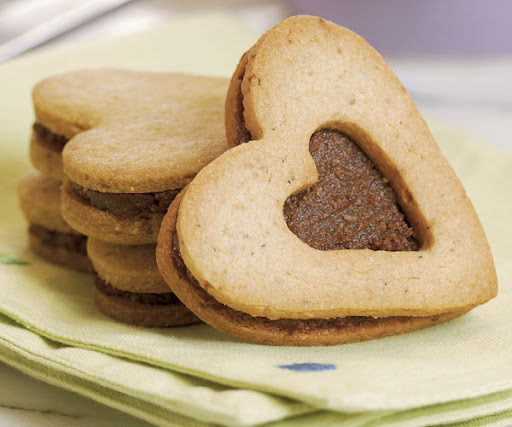
Gianduia Sandwich Cookies

The wafers for these cookies are delicious served on-their own as an accompaniment to Gianduia Mousse.  See my Hazelnut Butter recipe for instructions on toasting and skinning the nuts.
For the filling:
  • 3 oz. bittersweet or semisweet chocolate, finely chopped
  • 1 oz. milk chocolate, finely chopped
  • 1/4 cup heavy cream
  • 1/2 cup Hazelnut Butter, at room temperature
Tip:
Use the best chocolate you can find; try www.bakingshop.com and www.qzina.com for mail-order sources.
For the cookies:
  • 9 oz. (2 sticks plus 2 Tbs.) unsalted butter, softened
  • 1 cup sugar
  • 1 cup (5 oz.) toasted, skinned, and finely ground hazelnuts (grind the toasted nuts in a food processor)
  • 4 large egg yolks, at room temperature
  • 1 tsp. vanilla extract
  • 13-1/2 oz. (3 cups) all-purpose flour, mixed with a pinch of salt

Make the cookie filling:

In a metal bowl set over a saucepan of simmering water, melt the bittersweet (or semisweet) and milk chocolate, stirring frequently with a rubber spatula to ensure even melting. In a small saucepan, heat the cream over medium heat to just below the boiling point. Remove the bowl of chocolate from the pan of water and wipe the bottom and sides dry. Pour the cream into the chocolate and stir with the spatula until very smooth. Stir in the hazelnut butter until well blended. Cover tightly with plastic wrap. Cool to room temperature and refrigerate until thick but not stiff, about 2 hours, stirring occasionally with the spatula. If you make the filling in advance and it has become very firm, leave it at room temperature until it reaches a nice spreading consistency.

Make the cookies:

In the bowl of a stand mixer using the paddle attachment (or in a large mixing bowl using a hand-held mixer), beat the butter until fluffy, about 2 minutes. Add the sugar and beat until well blended. Add the ground hazelnuts and mix well. Stop occasionally and scrape the sides and bottom of the bowl with a rubber spatula.

Add the egg yolks, one at a time, mixing thoroughly after each addition. Mix in the vanilla extract, and then add the flour in two or three batches, mixing to blend well, but don’t overmix. Divide the dough, shape into two thick disks, wrap in plastic, and chill until firm, about 3 hours. (If the dough isn’t thoroughly chilled, it will be too soft to roll out and cut.)

Adjust the oven racks to the upper and lower thirds of the oven and heat it to 375°F.

Line four baking sheets with parchment. Work with one disk at a time; leave the other in the refrigerator. Try to work in a cool area, not too close to the warm oven. Roll the dough between sheets of lightly floured waxed paper or parchment until it’s about 1/8 inch thick for sandwich cookies, 1/4 inch for single cookies.

Cut out shapes using a cookie cutter. To make a “window” in the top cookie, in half of the shapes, cut out the center using a smaller cutter. Put the cookies on the lined baking sheets, leaving at least 1/2 inch between each wafer. Gently press the scraps together, reroll, and cut more wafers. If the dough is too warm and hard to work with, return it to the refrigerator to chill.

Bake two sheets at a time (keeping the others in the refrigerator) for 7 minutes and then switch the sheets to the opposite racks. Bake for another 6 to 7 minutes, until deep golden on the top and the bottom. Keep a close eye on the baking time, and keep in mind that the cookie tops may be finished a minute earlier than the bottoms. Let cool on racks. The wafers must be cooled completely before assembling the cookies.

To assemble:

Use a small metal spatula or table knife to to spread some of the filling onto each wafer bottom. Place one of the wafer tops on top of the filling, pressing slightly so they stick together.  Store the sandwich cookies at room temperature between layers of waxed paper, tightly covered with aluminum foil in a plastic container, for up to three days.

Monday, November 11, 2013

Dark Chocolate Soufflé Cakes with Espresso-Chocolate Sauce

An espresso twist on the iconic molten-chocolate cake.
  • Softened butter and granulated sugar for the ramekins
For the espresso-chocolate sauce:
  • 1 tsp. instant espresso powder
  • 8 oz. bittersweet or semisweet chocolate, coarsely chopped
  • 3 oz. (6 Tbs.) unnsalted butter, cut into eight  pieces
  • Table salt
For the soufflé cakes:
  • 2 Tbs. unsweetened natural cocoa powder
  • 2 large eggs, separated
  • 1 large egg white
  • 1/8 tsp. cream of tartar
  • 3 Tbs. granulated sugar

Put a metal or Pyrex pie plate or cake pan in the freezer to chill. Lightly butter six 6-oz. ramekins or custard cups. Coat with sugar and tap out the excess.

Make the sauce:

In a small bowl, combine the espresso powder with 2 Tbs. warm water and stir to dissolve.

In a medium heatproof bowl set in or over a skillet of barely simmering water, melt the chocolate and butter, stirring frequently, until smooth. Add two pinches of salt, stir, and remove from the heat. Transfer 5 Tbs. of the chocolate mixture to the espresso and stir to blend. (Set the remaining melted chocolate aside.) Use a spatula to scrape the espresso mixture into a puddle on the chilled pie plate or cake pan and return to the freezer until firm, about 10  minutes. When the espresso-chocolate mixture is firm, use a teaspoon to scrape it into six rough balls. Keep the balls on the plate and refrigerate until ready to use.

Make the soufflé cakes:

Reheat the remaining chocolate mixture by setting its bowl in or over the skillet of hot water. When it’s warm, remove from the heat and whisk in the cocoa and the 2 egg yolks.

In a clean, dry bowl, beat the 3 egg whites and cream of tartar on medium speed in a stand mixer (or on high speed with a hand-held mixer) until the whites mound gently. Gradually beat in the sugar and beat until the whites form medium-stiff peaks when you lift the beaters; the tips should curl over but still look moist, glossy, and flexible. With a rubber spatula, fold about one-quarter of the egg whites into the chocolate to lighten it. Scrape the remaining whites into the bowl and gently fold in until blended, taking care not to deflate the whites. Take the chocolate balls out of the refrigerator and put one ball in the center of each ramekin. Divide the batter evenly among the ramekins and level the tops gently with the back of a spoon.

Position a rack in the lower third of the oven; heat the oven to 400°F. Put the ramekins on a baking sheet. Bake until the soufflé cakes are puffed and possibly a little cracked on top (a toothpick inserted in the center will meet no resistance and emerge mostly clean—the tip will be wet from the sauce at the bottom), 11 to 14 min. Let cool for a few minutes before serving.

Whole-Wheat Chocolate Chip Cookies

These cookies are the size of your palm, with thick, chewy edges, soft centers, and big chocolate chunks. It’s surprising just how delicious this whole-wheat version of an old classic is. This cookie is made with 100% whole-wheat flour, which gives it a distinctive, nutty taste. Use a good bittersweet chocolate for these cookies, as the flavor of high-quality chocolate pairs best with whole-wheat flour.
For the dry mix:
  • 3 cups whole-wheat flour
  • 1-1/2 tsp. baking powder
  • 1 tsp. baking soda
  • 1-1/2 tsp. kosher salt
For the wet mix:
  • 8 oz. (2 sticks) cold unsalted butter, cut into 1/2-inch pieces
  • 1 cup dark brown sugar
  • 1 cup sugar
  • 2 eggs
  • 2 tsp. pure vanilla extract
  • 8 oz. bittersweet chocolate, roughly chopped into 1/4- and 1/2-inch pieces

Place two racks in the upper and lower thirds of the oven and preheat to 350°F. Line two baking sheets with parchment. Although you can butter the sheets instead, parchment is useful for these cookies because the large chunks of chocolate can stick to the pan.

Sift the dry ingredients into a large bowl, pouring back into the bowl any bits of grain or other ingredients that may remain in the sifter.

Add the butter and the sugars to the bowl of a standing mixer fitted with a paddle attachment. With the mixer on low speed, mix just until the butter and sugars are blended, about 2 minutes. Use a spatula to scrape down the sides of the bowl. Add the eggs one at a time, mixing until each is combined. Mix in the vanilla. Add the flour mixture to the bowl and blend on low speed until the flour is barely combined, about 30 seconds. Scrape down the sides and bottom of the bowl.

Add the chocolate all at once to the batter. Mix on low speed until the chocolate is evenly combined. Use a spatula to scrape down the sides and bottom of the bowl, then scrape the batter out onto a work surface, and use your hands to fully incorporate all the ingredients.

Scoop mounds of dough about 3 Tbs. in size onto the baking sheet, leaving 3 inches between them, or about 6 to a sheet.

Bake the cookies for 16 to 20 minutes, rotating the sheets halfway through, until the cookies are evenly dark brown. Transfer the cookies, still on the parchment, to the counter to cool, and repeat with the remaining dough.